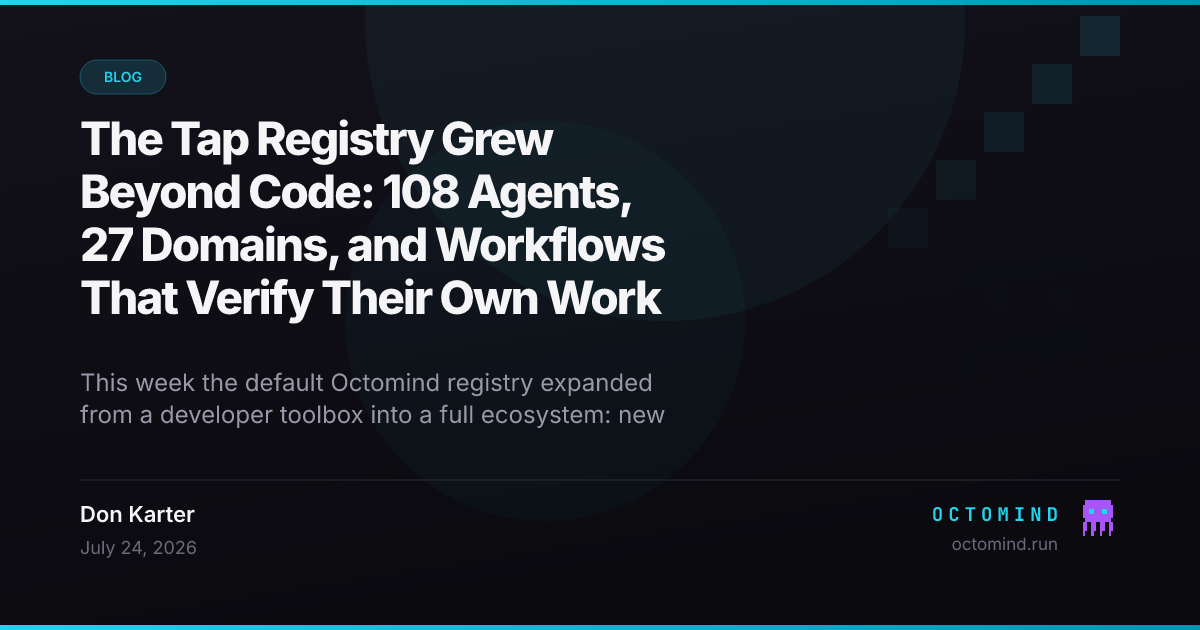
The cloud launch got the spotlight this week. But quietly, in parallel, the thing most Octomind sessions actually start from — the tap registry — went through its biggest expansion since we introduced taps. The default registry now holds 108 agents across 27 domains, 71 capabilities, and 18 workflows, and every one of them is a single command away from any Octomind install. No downloads, no marketplace accounts, no setup.
If you followed yesterday's quickstart, you already used it without noticing: developer:general — the agent that fixed the bug in that post — is a tap agent, fetched and merged into your config at runtime. Today's post is about everything that appeared around it.
Thirty seconds on what a tap is
A tap is a git-hosted registry of TOML manifests. Each manifest defines one agent — system prompt, model, tools, MCP servers — and Octomind fetches it at run time and merges it into your config. Nothing is installed; there's no global state to rot. The official muvon/octomind-tap ships as the default, so this works out of the box:
octomind run developer:rust      # a Rust specialist
octomind run lawyer:immigration  # an immigration-law explainer
octomind workflow harden         # a multi-step security audit pipeline
The tag format is domain:spec, the registry is browsable on the site, and adding your own registry is one octomind tap <url> away — the whole point of the design is that we don't get to be the only publisher. The original rationale still holds: agents should be distributed like code, reviewable in a diff, not installed like apps.
The registry stopped being just for developers
The biggest shift this week is who the agents are for. The registry began as a developer toolbox — and that part keeps growing — but most problems people bring to an agent aren't code. So the ecosystem now covers them, one specialist at a time. New this week alone:
- Family —
family:parenting,family:eldercare, andfamily:bereavement, an agent for the paperwork and decisions that arrive at the worst possible time, written with the gravity that moment deserves. - Finance —
finance:tax,finance:retirement,finance:insurance. - Health & wellbeing —
doctor:sleep,coach:wellbeing,coach:negotiation. - Everything else life throws at you —
lawyer:immigration,home:realty,vet:generalandvet:behavior,vehicle:mechanic,tutor:coding,content:fiction.
That's seventeen new agents, joining domains like chef, travel, launch, and sales that were already there. To be plain about what these are: structured, well-prompted assistants that help you prepare, organize, and understand — not replacements for a licensed professional when a decision genuinely needs one. The value is that the preparation, which is 80% of the work, no longer starts from a blank page.
And if you don't know which specialist you need, you don't have to: assistant:concierge routes across the whole ecosystem, and the orchestrator you get from a bare octomind run discovers matching specialists by intent — you saw it do exactly that in yesterday's transcripts.
Four new workflows, and they all close the loop
Workflows are multi-step TOML pipelines — each step its own agent, model, and toolset, with validate scripts as deterministic quality gates between steps. Four new ones landed, and the pattern they share is the one we keep betting on: don't stop at the first answer; loop until the check passes.
-
harden— an OWASP-lens security audit of the current repo, then a fix ⇄ re-audit loop until findings are resolved and the project's own checks stay green. -
upgrade— dependency bumps (named packages, or safe patch/minor by default) in a bump ⇄ verify loop until the build is green again. -
scout— the phase before anyone has an idea: take a field or market, mine it for real, evidenced pain through three blind parallel sweeps, and come back with vetted opportunities instead of vibes. -
learn— bootstrap a project knowledge base: read the codebase, extract the durable facts, and promote them into.box/where they're indexed and readable by every agent that works on the project after.
They run like everything else — octomind workflow harden — reading input from stdin and writing the final result to stdout, which makes them scriptable by construction. That brings the registry to eighteen workflows, from localize and promote to deep-review.
Agents that remember the project
learn is one half of a bigger addition: a knowledge system now runs through the registry. A new octobrain-backed knowledge capability gives agents durable project memory, assistant:knowledge curates it, and the learn workflow seeds it from your codebase. The result is the thing everyone actually wants from "AI that knows my project": facts extracted once, stored in the repo's .box/ directory, available to every specialist that touches the project afterward — the octobrain integration doing what it was built for.
The unglamorous fixes that make it work everywhere
Two smaller changes, both born from real friction:
- Dependency installs now work in containers and CI. Tap agents bootstrap their own tooling (Node for MCP servers, for instance), and those scripts assumed
sudoexists. Root containers — Docker, CI images, the environment from yesterday's tutorial — don't have it. Every dep script now escalates through a helper that runs bare as root, usessudowhen present, and says exactly what's missing otherwise. - Web search needs no API key. The websearch capability defaults to DuckDuckGo now — one less credential between a fresh install and a working researcher agent, in the same spirit as the hub's zero-key login.
Use it anywhere octomind runs
Everything above works on the Octomind you install with one curl command on your laptop — and it's all preloaded on cloud machines too, where the same agents run with real Docker and survive your laptop lid. Models come through the hub with the default octohub:auto routing, so there's no setup between "I have a question about my lease" and octomind run lawyer:immigration.
Browse the full registry at octomind.run/tap, or read the manifests themselves at github.com/Muvon/octomind-tap — they're TOML files, reviewable in one sitting, and contributions are open. If there's a specialist you keep wishing existed, it's one manifest away — and if you build one, we'd genuinely like to see it.